
Garissa County Teaching and Referral Hospital Chief Executive Officer (CEO) Mahat Sheikh Salah has called for enhanced screening and immunohaematological testing of donated blood, saying the measures are critical to improving patient safety and ensuring safe blood transfusion services.
Mr. Mahat said the hospital is implementing the National Algorithm for Screening of Donated Blood and Immunohaematological Testing, a Ministry of Health guideline aimed at ensuring all donated blood undergoes rigorous laboratory testing before being transfused to patients.
“The safety of patients remains our highest priority. Every unit of donated blood must be properly screened to protect recipients from transfusion-transmissible infections and to ensure compatibility,” Mahat said.
According to the Ministry of Health guidelines, donated blood should be screened for HIV, Hepatitis B, Hepatitis C, and Treponema pallidum (syphilis), in addition to blood grouping and immunohaematological testing.
The algorithm also outlines procedures for antibody identification, ABO and RhD typing, compatibility testing, and quality assurance.
CEO Mahat Sheikh Salah noted that adherence to the national testing algorithm strengthens confidence in blood transfusion services.
He said Garissa County Teaching and Referral Hospital has ensured that laboratory procedures are standardized, reliable, and consistent with national policy.
“Blood transfusion saves lives every day—from mothers experiencing severe bleeding during childbirth to accident victims and children suffering from severe anaemia. Ensuring every unit of blood is safe is a responsibility we all share,” he added.
The CEO further encouraged voluntary blood donation, saying a steady supply of safe blood is essential for both emergency and routine medical care.
He called on residents, healthcare workers, and development partners to support initiatives aimed at improving blood donation and strengthening laboratory capacity.
The Ministry of Health’s national algorithm emphasizes that the effective implementation of standardized blood screening procedures will significantly reduce the risk of transfusion-transmissible infections and adverse transfusion reactions while improving patient outcomes across Kenya’s healthcare system.
Garissa County Teaching and Referral Hospital is strengthening laboratory services and quality assurance measures in line with the national framework to ensure patients receive safe and compatible blood whenever transfusions are required.
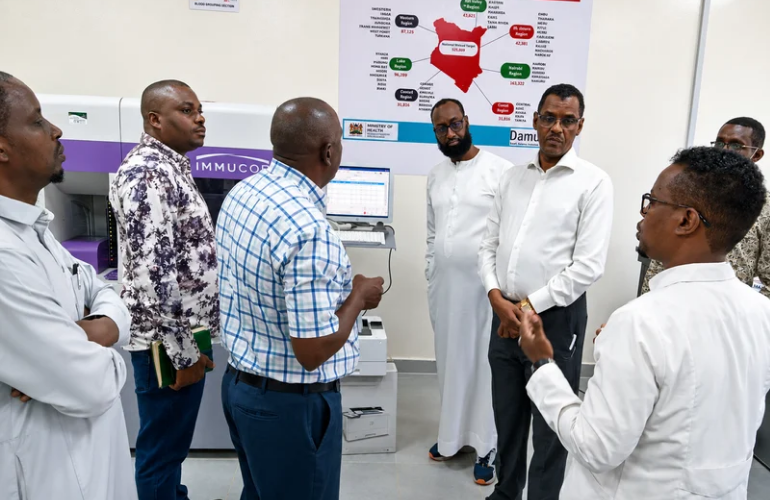
The Northern Regional Blood Transfusion Centre at Garissa County Teaching and Referral Hospital, launched in June, is part of efforts to expand access to safe blood services across North Eastern Kenya and neighbouring regions.
The centre has been equipped with modern screening technology and expanded storage systems capable of supporting the processing of more than 40,000 units of blood each year.
It will provide blood screening, storage, and transfusion services to residents of Garissa, Wajir, Mandera, Tana River, and parts of Isiolo and Kitui counties.