

Garissa has never been short of stories. Its people, pastoral heritage, resilient communities, thriving trade networks and strategic position in the Horn of Africa offer a wealth of stories waiting to be told. Yet, for decades, the county’s economic conversation has revolved largely around livestock, public employment, humanitarian interventions and government investment. There is another opportunity that deserves equal attention: the creative economy.
From film production and broadcasting to digital journalism, photography, music, advertising and technology, the creative industry could become an important source of employment and enterprise for Garissa’s growing youth population. The question is whether we are prepared to invest in it.
For me, this is more than an economic argument. It is a personal ambition shaped by years of working in media across Africa and a determination to build something lasting in Northern Kenya.
𝐁𝐮𝐢𝐥𝐝𝐢𝐧𝐠 𝐚 𝐦𝐞𝐝𝐢𝐚 𝐢𝐧𝐝𝐮𝐬𝐭𝐫𝐲 𝐰𝐡𝐞𝐫𝐞 𝐧𝐨𝐧𝐞 𝐞𝐱𝐢𝐬𝐭𝐞𝐝
My journey towards this ambition was influenced by experiences beyond Kenya’s borders. Having worked across the African region, contributing to the establishment of radio and television stations, I came to appreciate the power of broadcasting as an instrument of economic development, public engagement and cultural expression.
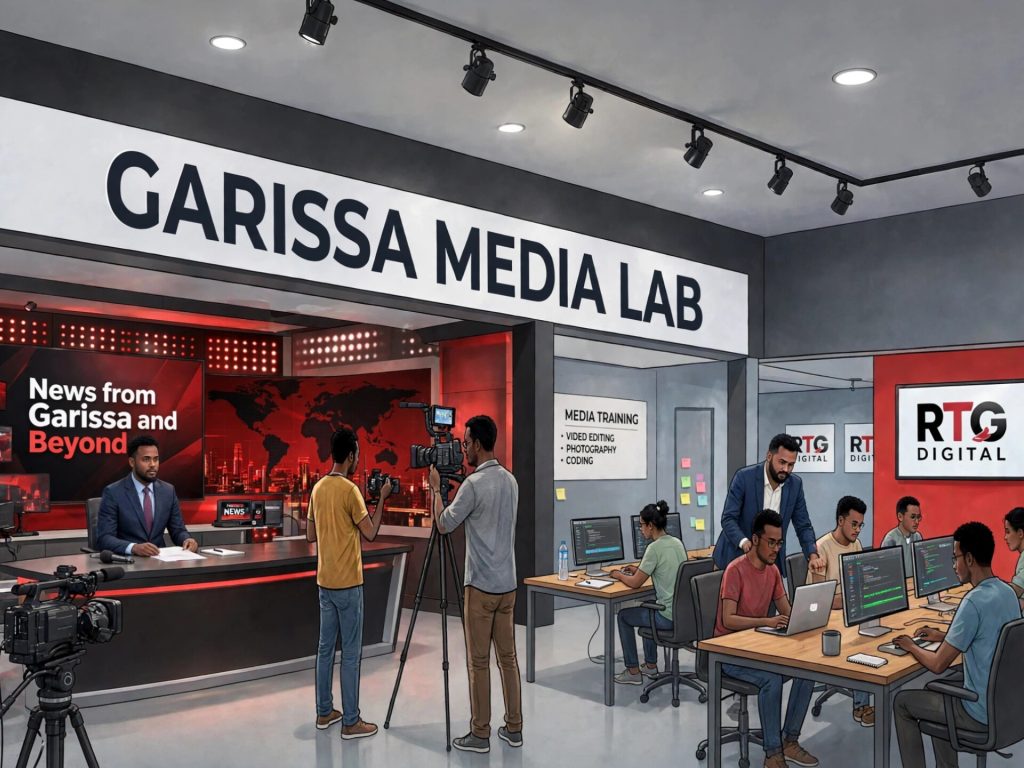
Presenters and trainees producing live radio – news, talk, music and community conversations from the heart of Garissa.
My professional experience in Mogadishu, Somalia, where I served as a press officer, analyst, public relations advisor, diplomatic and political analysis support to key foreign missions, further shaped my understanding of strategic communication and the importance of media institutions.
When I returned home, I saw an opportunity that had remained largely neglected. Northern Kenya had a wealth of human experiences and development stories, but lacked sufficient locally rooted media infrastructure to tell them consistently.
The region was frequently represented through narratives of insecurity, drought and marginalisation. These challenges are real, but they are not the entirety of our story. There are entrepreneurs building businesses, young people embracing technology, institutions expanding services and communities pursuing new opportunities.
I wanted to help change the narrative.
In 2020, I established Royal Halann Services and launched Garissa Today, which later evolved into RTG Digital. The organization was established to provide video and audio production, public relations, and strategic communications support.
Garissa Today became the company’s first media initiative and the foundation of a broader ambition to establish a sustainable media enterprise from Garissa.
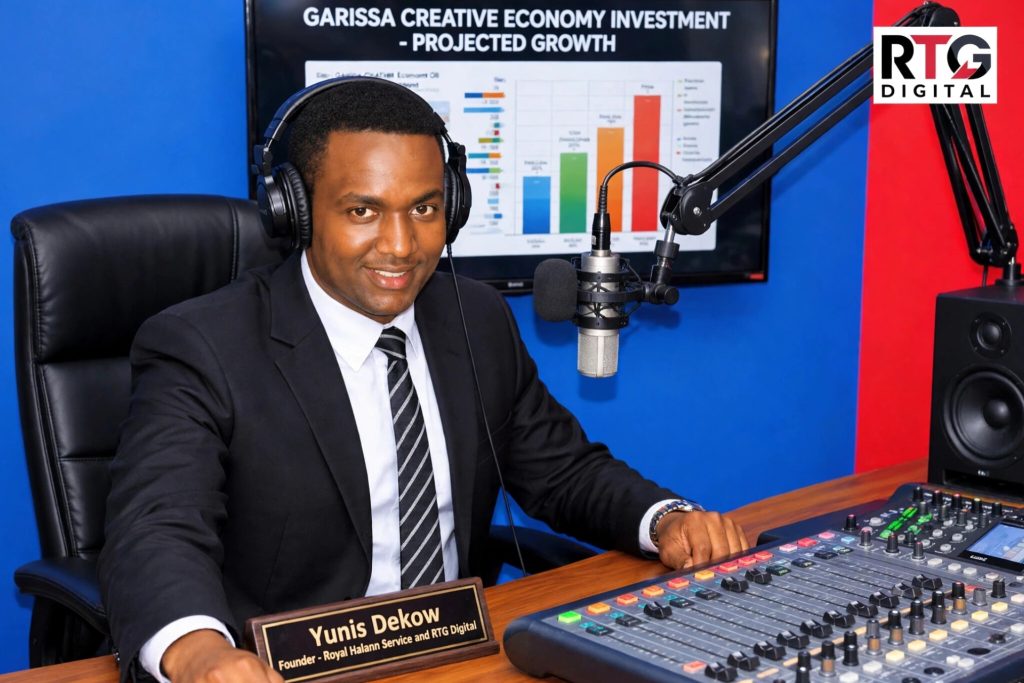
Mr. Yunis Dekow, founder of Royal Halann Services and RTG Digital, advocates for investment in Garissa’s creative economy.
RTG Digital has since expanded to a Radio and Television and maintains a dedicated commitment to reporting on Garissa, providing consistent coverage of local developments and amplifying stories that might otherwise struggle to find national attention.
The ambition has always been to build a media institution with the capacity to serve the region and compete in a rapidly changing digital environment.
𝐓𝐡𝐞 𝐚𝐦𝐛𝐢𝐭𝐢𝐨𝐧 𝐭𝐨 𝐩𝐮𝐭 𝐆𝐚𝐫𝐢𝐬𝐬𝐚 𝐨𝐧 𝐭𝐡𝐞 𝐛𝐫𝐨𝐚𝐝𝐜𝐚𝐬𝐭𝐢𝐧𝐠 𝐦𝐚𝐩
One of my most significant ambitions has been establishing the first multilingual radio and television broadcasting station operating from Garissa in history.
For a county of Garissa’s size and strategic importance, the absence of a strong locally established broadcasting infrastructure represents a missed opportunity.
A radio and television station is more than a news and entertainment outlet. It would be an economic enterprise capable of employing journalists, presenters, producers, editors, camera operators, sound engineers, technicians, marketers and digital content creators.
It provides a platform for local artists, filmmakers, entrepreneurs, educators and cultural practitioners. It would also give businesses an opportunity to advertise, reach customers and participate in a growing regional marketplace.
Most importantly, it would allow Garissa to tell its own stories, preserve its cultural identity and communicate with audiences across Kenya and the Horn of Africa.
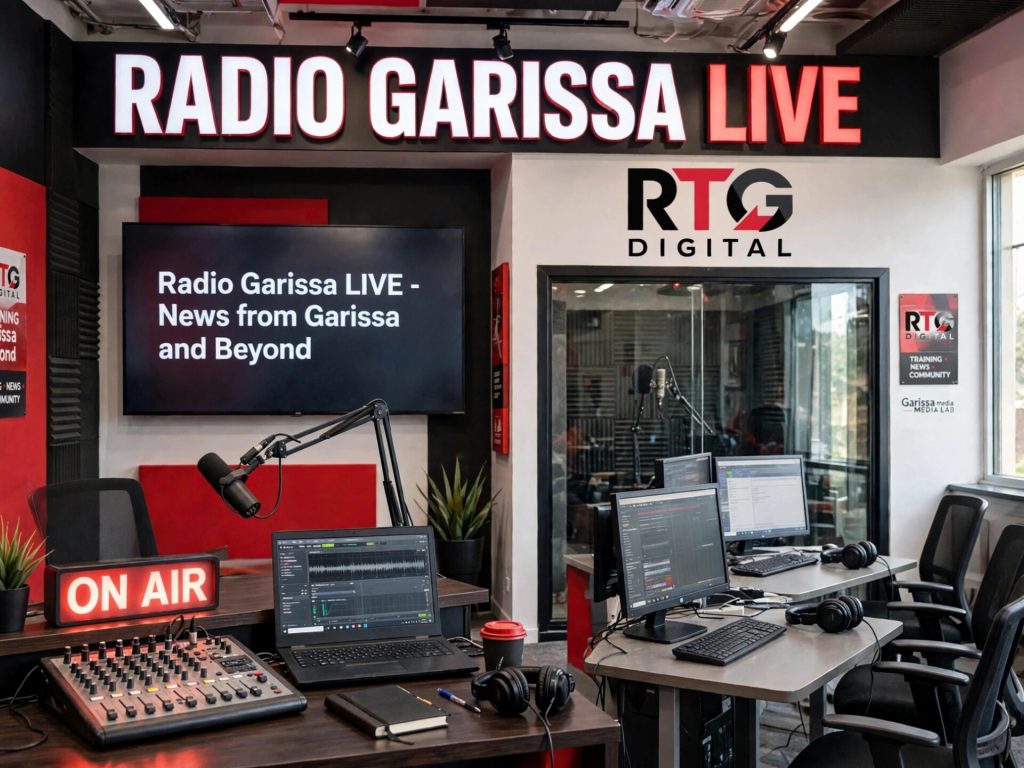
A professional, fully-equipped radio studio by RTG Digital. Community news, youth voices, and local stories – broadcast live from Garissa.
I see broadcasting as an investment in an institution that future generations can build upon.
𝐓𝐡𝐞 𝐦𝐢𝐬𝐬𝐢𝐧𝐠 𝐥𝐢𝐧𝐤: 𝐆𝐚𝐫𝐢𝐬𝐬𝐚 𝐌𝐞𝐝𝐢𝐚 𝐋𝐚𝐛
However, infrastructure alone cannot create an industry. We must invest in people.
This is the thinking behind Garissa Media Lab, a modern digital media and innovation training centre designed to equip young people, journalists, students, entrepreneurs and content creators with practical, market-oriented skills.
Its mission is to bridge the digital skills gap in Northeastern Kenya through affordable and accessible training in journalism, multimedia production, digital communication, leadership, entrepreneurship and emerging technologies.
The objective is to move young people from interest to competence, and from competence to enterprise.
A young person trained in photography should be able to establish a photography business. A trainee in video production should have the skills to develop a production company. Someone who understands digital marketing should be able to provide services to businesses and institutions across the region.
We must produce creators, professionals and entrepreneurs, not simply certificate holders.
Garissa Media Lab has become a place where ideas are developed, skills are sharpened and young people discover that they can build successful careers without necessarily relocating to Nairobi.
𝐓𝐮𝐫𝐧𝐢𝐧𝐠 𝐜𝐫𝐞𝐚𝐭𝐢𝐯𝐢𝐭𝐲 𝐢𝐧𝐭𝐨 𝐞𝐦𝐩𝐥𝐨𝐲𝐦𝐞𝐧𝐭
Garissa has a considerable youth unemployment challenge. Traditional employment pathways cannot absorb every young person entering the labour market. We must therefore broaden our understanding of what constitutes an economically productive career.
Consider the possibilities in film production. A single production can engage actors, screenwriters, directors, cinematographers, editors, sound technicians, makeup artists, costume designers, drivers and catering businesses.
A television programme creates work for an entire production team. A digital agency requires graphic designers, photographers, videographers, developers and communication professionals. Music production, podcasting, animation and advertising offer further opportunities.
Garissa has the cultural richness, landscapes, history and human experiences to support such an industry. Its pastoral communities, urban transformation, traditional architecture and connections to the wider Horn of Africa offer compelling material for documentaries, films and television productions.
Imagine Garissa becoming a destination for filmmakers, with local production companies employing hundreds of young people and locally produced documentaries reaching international audiences.

This is not an impossible dream. It requires deliberate investment, training, infrastructure and access to markets.
𝐀 𝐜𝐚𝐥𝐥 𝐟𝐨𝐫 𝐢𝐧𝐯𝐞𝐬𝐭𝐦𝐞𝐧𝐭 𝐚𝐧𝐝 𝐫𝐞𝐜𝐨𝐠𝐧𝐢𝐭𝐢𝐨𝐧
One of the biggest obstacles facing creative entrepreneurs in Northern Kenya is inadequate funding and institutional support. Equipment, studios, software, internet connectivity and professional training require substantial investment. Yet emerging enterprises often struggle to access affordable financing.
County governments, national institutions, development partners, private investors and financial institutions must recognise the economic value of the creative sector.
We need creative industry incubation programmes, equipment financing, production grants, business mentorship and partnerships between training institutions and established media organisations.
Public institutions should also create fair opportunities for credible local media businesses to provide advertising, production and communication services.
Supporting a media start-up is not merely supporting an individual entrepreneur. It is investing in jobs, skills, local storytelling and the development of an industry.
Those who take risks to establish businesses in underserved regions should be recognised and encouraged. Positive change does not come exclusively from government offices. It also comes from entrepreneurs who identify opportunities and invest in making them possible.
𝐀 𝐥𝐞𝐠𝐚𝐜𝐲 𝐛𝐞𝐲𝐨𝐧𝐝 𝐛𝐫𝐨𝐚𝐝𝐜𝐚𝐬𝐭𝐢𝐧𝐠
My ambition is to see Garissa emerge as a regional centre for broadcasting, film production, digital innovation and creative entrepreneurship.
I want to see young people building production companies, producing films, managing digital agencies and competing in the global creative economy. I want to see local radio and television content reaching audiences beyond county borders, and Garissa becoming known not only for its pastoral heritage but also for its creative talent.
RTG Digital, the ambition to establish local radio and television broadcasting, and Garissa Media Lab are interconnected parts of that vision.
Ultimately, my legacy ambition is more than establishing a media company or broadcasting station. It is to help build an industry that can outlive its founders, employ generations of young people and give Northern Kenya a stronger voice.
Pastoralism will remain an important part of Garissa’s identity and economy. But our future must accommodate more possibilities. We must move from an economy defined by what we have traditionally produced to one that also recognises what our people can imagine, create and commercialise.
The next generation will not require to leave Garissa to find its place in the creative economy.
Our responsibility is to build the platforms, develop the skills and create the opportunities that allow them to build that future here.