

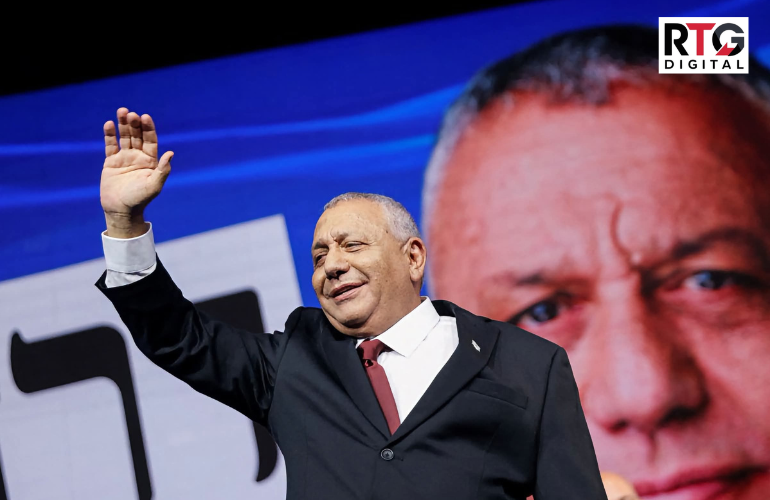
Israeli President Isaac Herzog has tasked former military chief Gadi Eisenkot with forming the country’s next government, handing him an opportunity to end Benjamin Netanyahu’s lengthy tenure as prime minister.
Herzog informed Eisenkot of his decision on Saturday evening, with a formal presentation of the mandate scheduled for Sunday, according to the president’s spokesperson.
The decision followed consultations with political parties after Israel’s October 27 general election failed to produce a parliamentary majority.
Eisenkot, leader of the Yashar party, received recommendations from 67 lawmakers, including members of Arab-led parties, compared with 46 who backed Netanyahu.
He now has 28 days to assemble a governing coalition, with a possible 14-day extension. A government requires the support of at least 61 members of the 120-seat Knesset.
Eisenkot’s four-party alliance secured 48 seats in the election, while Netanyahu’s right-wing and religious bloc won 53. Arab-led parties secured a record 19 seats, giving them significant influence in the coalition negotiations.
Despite receiving their backing, Eisenkot has ruled out forming a government directly with Arab-led parties.
Instead, he could seek support from the ultra-Orthodox parties, United Torah Judaism and Shas, which would give him the 61 seats required for a parliamentary majority.
Another possibility is a minority government relying on external parliamentary support from Arab-led lawmakers.
Reporting from Ramallah, Al Jazeera correspondent Nour Odeh said Herzog’s decision reflected the recommendations received during consultations, but warned that the difficult task of securing a workable parliamentary majority now lay ahead.
Ahmad Tibi, a senior member of the Joint List, which holds 11 seats, said Arab-led parties supported Eisenkot primarily to prevent Netanyahu from remaining in power.
Tibi described the decision as an opportunity to end the current government, particularly its association with far-right politicians Itamar Ben-Gvir and Bezalel Smotrich.
Netanyahu had earlier warned that an opposition-led government dependent on Arab-party support would threaten Israel’s stability.
Eisenkot, who served as Israel’s military chief between 2015 and 2019, also served as an observer in Netanyahu’s war cabinet during the first eight months of Israel’s war on Gaza, which began in October 2023.
The coalition negotiations are expected to test whether Israel’s opposition parties can overcome their political differences and secure enough parliamentary support to establish a new administration.
If Eisenkot fails, Herzog can nominate another candidate. Should subsequent efforts also fail, Israel could be forced into another election within 90 days, with Netanyahu remaining as caretaker prime minister.
The developments mark a critical moment in Israeli politics, with Arab-led lawmakers emerging as influential players in determining the country’s next government.