
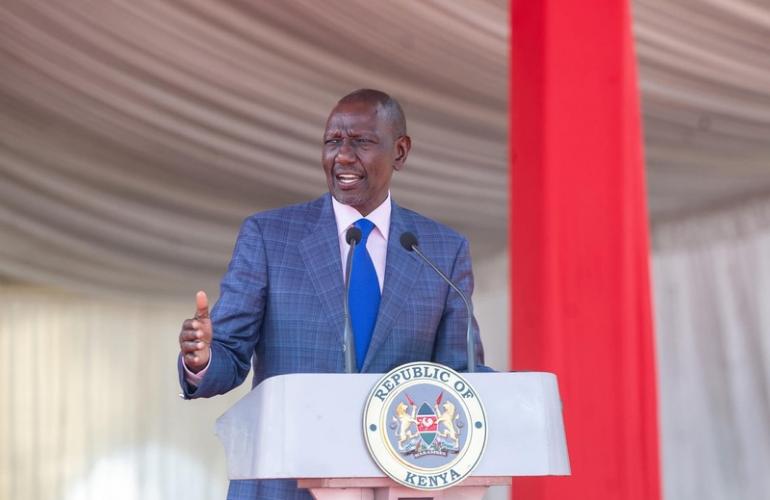
President William Ruto has declared micro, small and medium-sized enterprises (MSMEs) the central pillar of Kenya’s future prosperity, warning that without bold action to close a KSh3tn (£18bn) financing gap, the country’s economic transformation will stall.
In a wide-ranging address on Saturday, Ruto positioned the sector – which he said accounts for more than 90% of non-farm jobs and over 40% of GDP – as the true “engine room” of the Kenyan economy, rather than a peripheral concern.
“When we speak about the future of Kenya’s economy, we are speaking above all about the future of our micro, small and medium enterprises. Their success is ours. Their growth is our transformation,” the president said.
Ruto argued that MSMEs are not a side issue but the mainstream of economic life, both in Kenya and globally. He pointed to Germany, where more than 99% of businesses are small and medium-sized, providing nearly 60% of jobs and more than half of national output, including thousands of “hidden champions” that dominate specialised global markets.
“That is our destination,” he said. “The MSME is not the waiting room of our economy. It is the engine room.”
Government reforms and support programmes
The president detailed a series of reforms and initiatives his administration has launched to ease the path for small businesses. These include the establishment of a dedicated State Department for MSMEs, the digitisation of more than 25,800 public services, and sharp cuts to business registration costs – from KSh50,000 to KSh11,000, with informal groups able to formalise for as little as KSh550.
Through the Hustler Fund, nearly KSh90bn has been disbursed to more than 27 million Kenyans, accompanied by efforts to rehabilitate borrowers previously blacklisted by credit reference bureaus. Ruto said more than 2 million Kenyans have already repaid loans and re-entered the formal economy, with plans to develop a national credit scoring system based on character and behaviour rather than traditional collateral such as title deeds or logbooks.
Other programmes highlighted include NYOTA, aimed at skilling and capitalising more than 800,000 young people across every ward, and investments in sector-specific enterprise clusters in leather, textiles, dairy and edible oils. The government has also committed KSh5bn to support cooperatives in the livestock sector and built nearly 500 new markets, many with cold storage and internet access.
Under the flagship Affordable Housing Programme, 72 product lines have been ring-fenced exclusively for local juakali (informal sector) artisans, unlocking a KSh60bn opportunity that has already generated contracts for more than 33,000 small producers.
The financing challenge
Despite these measures, Ruto acknowledged that meaningful progress is constrained by chronic difficulties in accessing affordable credit. He described the KSh3tn MSME financing gap as the “one barrier that still stands on our MSMEs’ back” and noted that, while banks have provided KSh1tn in enterprise financing over the past three years, the majority of micro and small businesses remain locked out.
“Government funds can catalyse and prepare our people for credit, but government alone cannot close a [KSh3tn] financing gap. The private sector must participate,” he said.
The president framed the issue as both an economic imperative and a moral one, asking how Kenya can grow while “locking most of our people off the balance sheet”.
Call for innovation, citing Grameen Bank model
Drawing on the example of Muhammad Yunus and Bangladesh’s Grameen Bank, which provided collateral-free microloans to millions of the world’s poorest (mostly women) and won the Nobel Peace Prize, Ruto called for a similar mindset shift among Kenyan bankers.
“The cautious banker sees a Kenyan without a title or a logbook and says, there is no market here. But the innovator sees millions the system has yet to reach, and the single greatest banking opportunity in our nation,” he said.
“The unbanked are not a risk to be kept at arm’s length. They are a market waiting to be served.”
He urged the use of behavioural credit scoring, mobile technology and existing government-generated data to expand inclusion, citing Equity Bank’s origins as a Nairobi building society as proof that Kenyan institutions can scale such models successfully.
Ruto has appealed to entrepreneurs, bankers and policymakers, describing the task as a shared national responsibility in building “a nation of innovators”.
Kenya continues to navigate post-Covid recovery, high public debt pressures and youth unemployment, with MSMEs widely viewed as critical to job creation and inclusive growth.