
International leadership strategist, business consultant and author Dr. Mohamed Ahmed Bahaidar has urged young people to pursue character over comfort and reject the limiting beliefs that hold them back, saying true transformation begins with a change in mindset.
Addressing nearly 200 students in two seminars held over consecutive days in Vadodara, Gujarat, Dr. Bahaidar challenged participants preparing for competitive examinations and secondary school students to embrace resilience, discipline and personal responsibility as the foundations of success.
The seminars, titled “The Black Coffee Mindset: Building Unshakable Character in a World That Seeks Comfort” and “The Invisible Scars: Breaking Free from the Stories That Hold You Back,” formed part of his broader philosophy of developing individuals who are mentally resilient, emotionally grounded and purpose-driven.
Speaking during the first seminar on July 10 at the Muazzin Sher Zamaan Khan Pathan Seminar Hall, Jamia Mosque, Dr. Bahaidar told about 100 graduate students that meaningful success is rarely achieved through comfort.
Hosted by Dr. Mohamed Hussain, President of the Baroda Muslim Doctors Association, the session attracted candidates preparing for India’s highly competitive UPSC, GPSC, SSC, banking and police service examinations.
Using black coffee as a metaphor, Dr. Bahaidar argued that life’s “bitterness” represents discipline, sacrifice and perseverance, qualities he described as essential for long-term achievement.
“Don’t seek a sweeter life. Build a stronger character,” he told the audience.
He encouraged students to view hardship not as punishment but as an opportunity to develop emotional resilience and integrity, adding that intelligence alone is insufficient without the strength of character to endure adversity.
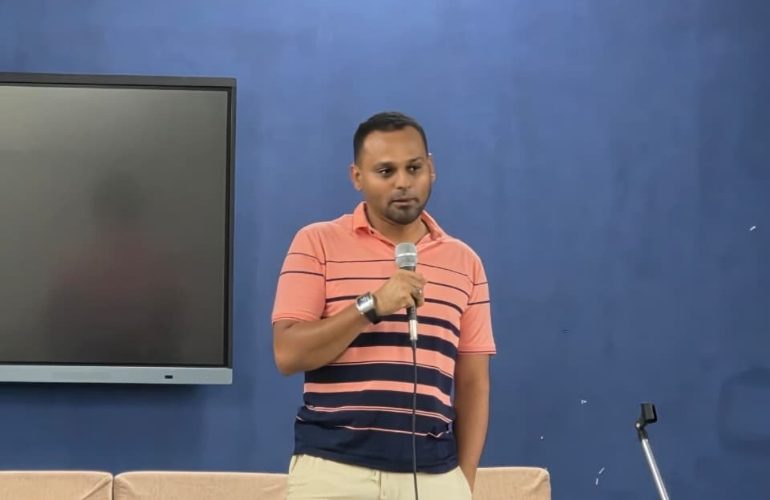
The following day, Dr. Bahaidar addressed another audience of about 100 students at M.E.S. English Medium School in Vadodara during a seminar hosted by Principal Ishrat Hotelwala and Almas Khan.
In his presentation, “The Invisible Scars,” he explored how deeply held perceptions and self-limiting beliefs often become greater obstacles than external circumstances.
Drawing on a psychology experiment reported by Professor Robert Kleck and colleagues in 1970, he described how participants who believed they had visible facial scars felt judged during interviews even after the scars had secretly been removed.
“The interviewers responded to ordinary people. The participants responded to an invisible belief,” he explained, arguing that perception often shapes behaviour more powerfully than reality itself.
He said many people continue to make life decisions based on fears, criticism and labels that no longer reflect their present reality.
Introducing what he called the “Compass Mindset,” Dr. Bahaidar said while people cannot change their past experiences, they can choose the direction of their future by changing how they think.
“When your perception changes, your direction changes. When your direction changes, your destination changes,” he said.
He urged students to reject fear and comparison, embrace purpose and principles, and refuse to allow past experiences to define their future.
The twin seminars reflected Dr. Bahaidar’s growing emphasis on inner transformation, arguing that lasting success is built through disciplined thinking, resilient character and purposeful living rather than temporary motivation.