

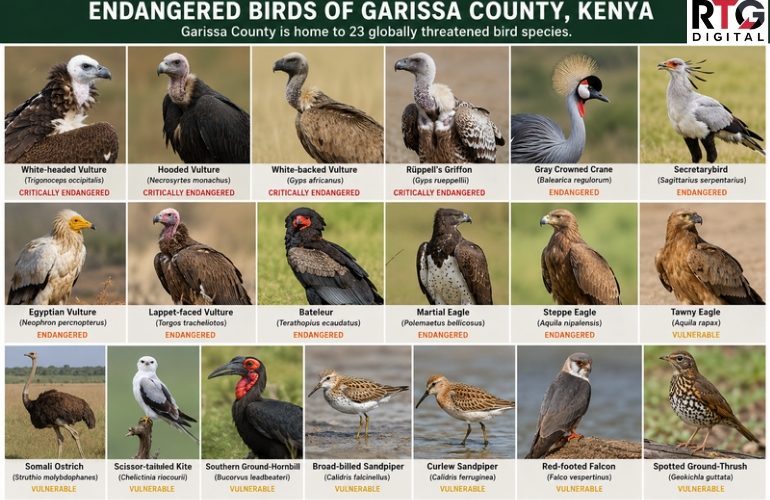
Garissa County is home to 23 globally threatened bird species, making it an important biodiversity hotspots, according to the latest Avibase Checklist of the Birds of Garissa.
The checklist records 525 bird species in the county, reflecting the rich diversity of habitats found across Garissa’s rivers, wetlands, woodlands and arid landscapes. The report also noted that four introduced bird species and confirmed that several globally threatened birds continue to occur within the county.
Among the critically endangered species recorded in Garissa are the White-headed Vulture, Hooded Vulture, White-backed Vulture and Rüppell’s Griffon. These scavengers play a crucial role in maintaining healthy ecosystems by removing animal carcasses and helping prevent the spread of disease.
Other endangered species found in the county include the Gray Crowned Crane, Secretarybird, Egyptian Vulture, Lappet-faced Vulture, Bateleur, Martial Eagle and Steppe Eagle. Their presence highlights the importance of Garissa’s rangelands and natural habitats for large birds of prey.
The checklist also identifies several vulnerable species, including the Somali Ostrich, Scissor-tailed Kite, Tawny Eagle, Southern Ground-Hornbill, Broad-billed Sandpiper, Curlew Sandpiper, Red-footed Falcon and Spotted Ground-Thrush.
Habitat loss, climate change, poisoning, illegal hunting and human activities have all threaten many bird populations across Africa. Vultures in particular have suffered sharp declines due to poisoning and loss of suitable habitats.
Garissa’s diverse ecosystems, including areas along the Tana River and vast pastoral landscapes, has provided important feeding, breeding and migratory habitats for resident and migratory bird species. The county also serves as a refuge for several species whose populations are declining elsewhere.
The findings highlight the need for continued conservation efforts to protect critical habitats and safeguard bird species facing extinction.
With more than 500 bird species recorded, Garissa remains one of Kenya’s most important regions for bird conservation and ecological diversity.