
Long before modern highways, devolved governments and frontier development projects, Wajir stood as one of northern Kenya’s earliest administrative and trading centres.
The dusty outpost played a critical role in colonial administration, regional security and cross-border commerce.
As the administrative capital of Wajir County prepares to host the 63rd Madaraka Day celebrations in 2026, renewed attention is turning to the historic northern town whose story mirrors the complex relationship between the Kenyan state and the marginalised frontier regions.
Wajir was founded in the early 20th century during British colonial expansion into the former Northern Frontier District (NFD). The town emerged as a strategic administrative station because of its location along key pastoral migration and trade routes linking present-day Kenya, Somalia and Ethiopia.
Colonial administrators established military camps, police posts and administrative offices in the town as Britain sought to consolidate control over the vast arid region inhabited largely by Somali pastoralist communities.
Transport CS Davis Chirchir has expressed satisfaction with the progress of ongoing road infrastructure projects in Wajir ahead of the 2026 Madaraka Day celebrations set to be hosted in the county next month.
The CS, who toured key projects across Wajir town alongside Wajir Governor Ahmed Abdullahi, praised contractors and implementing agencies for working to meet deadlines while maintaining construction standards.
The projects being undertaken by Kenya Urban Roads Authority include upgrading roads to bitumen standards, rehabilitation of damaged roads and improvement of drainage systems.
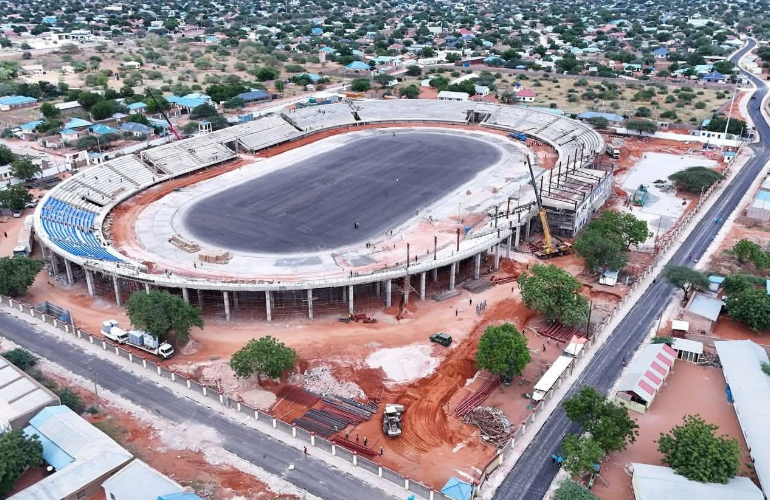
Among the projects inspected were the Furaha Girls–Wajir Stadium Road, the Stadium Ring Road, access roads to key public offices and the rehabilitation of the Airport Gate–Basabra–Furaha School Stadium Link Road.
The CS also assessed drainage works along the B13 Miyale Road and upgrades to access roads leading to the County Aggregated Industrial Parks in Wajir.
Ahead of the Madaraka Day celebrations, local leaders are calling for greater recognition of Wajir’s historical contribution to Kenya’s nationhood and frontier security.
Wajir South MP Mohamed Adow, a former journalist-turned-lawmaker, defended ongoing development projects in the region.
He commended the progress on long-awaited road infrastructure and urged voters to elect leaders based on performance rather than family ties.
“There’s been progress, but Northeastern is still a work in progress,” Adow said.
He described the ongoing road construction in the region as a historic breakthrough after decades of neglect.
“For the first time, we’re seeing contractors on the ground building the road we waited for for more than 60 years,” he said.
Wajir Deputy Governor Ahmed Muhumed Abdi said while the town was once viewed primarily through the lens of conflict and drought, it now represents resilience, survival and untapped economic potential.
He called for increased investment in infrastructure, education and trade corridors connecting northeastern Kenya to the rest of the country.
Historian Mohamed Ahmed said Wajir became one of the oldest formal towns in northern Kenya alongside Garissa and Marsabit, serving as a centre for tax collection, livestock regulation and security operations during the colonial era.
Ahmed said, however, that for many residents, the town’s history is also tied to decades of exclusion.
For years after independence in 1963, the former Northern Frontier District remained under heavy state surveillance following the secessionist Shifta conflict, which erupted after sections of the Somali population sought to join neighbouring Somalia.
The conflict transformed Wajir into a heavily militarised zone, with movement restrictions, emergency laws and economic neglect shaping everyday life for decades.
Older residents still recall the era when obtaining travel permits was mandatory and government presence largely revolved around security operations rather than development.
“Wajir has always existed at the centre of Kenya’s security history, but rarely at the centre of national development,” resident Mohamed Ganyure said.
He noted that the town has evolved into a resilient commercial hub driven by livestock trade, remittances and informal cross-border business networks connecting the Horn of Africa.
Today, camels, goats and cattle remain central to the local economy, while rapid urban expansion has transformed the once-isolated outpost into one of northeastern Kenya’s fastest-growing towns.
New roads, improved telecommunications and expanding education institutions are gradually reshaping the region’s image, although residents say major challenges persist in healthcare, water access and employment.
For many young residents, the conversation is no longer about survival alone but about inclusion and equal participation in Kenya’s future.
The commemoration of another year of self-rule in Wajir County serves as a reminder of both the unfinished legacy of marginalisation and the enduring importance of Kenya’s northern frontier in shaping the nation’s history.